


50+ Conversion Rate Optimisation Statistics for 2026
Dated, sourced, and evidence-graded CRO statistics for 2026 — covering DTC benchmarks, the mobile-desktop gap, cart abandonment, AI shopping agents, and the conversion levers with the strongest evidence.
UK-relevant, rigorously sourced, evidence-graded CRO statistics for 2026 — every figure dated, sourced, and methodology-flagged.

7 min read
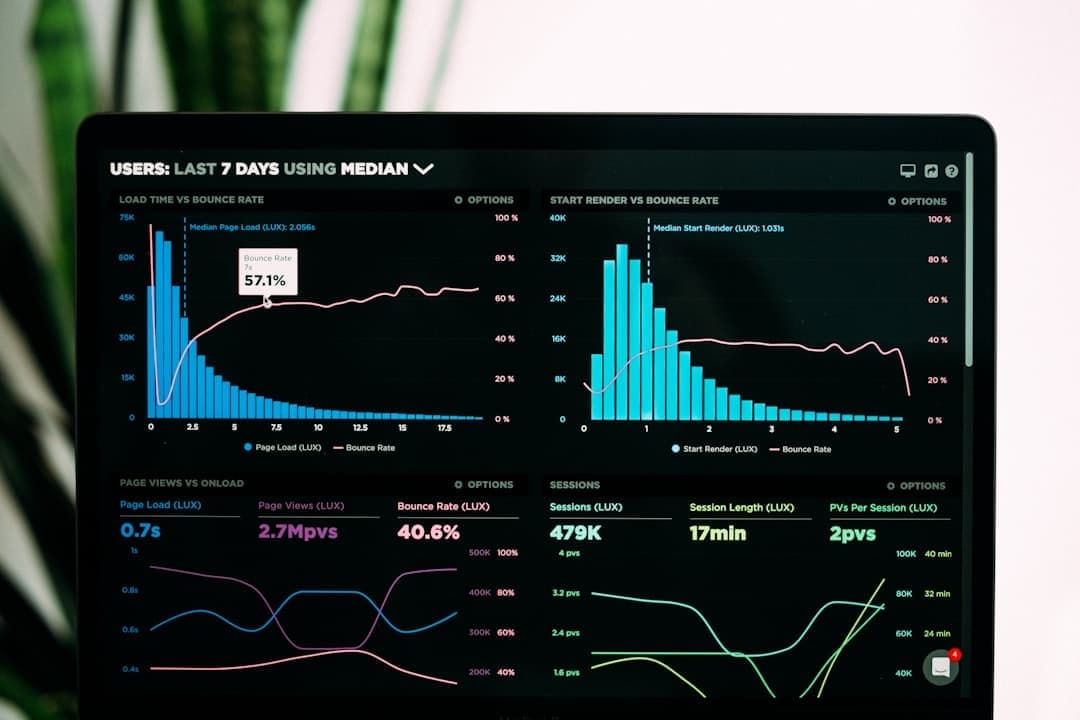
Photo by Luke Chesser on Unsplash
This post is part of our broader guide to The UK SME Guide to Conversion Rate Optimisation. If you want the full strategic picture before diving into the numbers, start there.
Most “CRO statistics” roundups recycle undated figures from unknown sources. We took a different approach. Every conversion rate optimisation statistic below is dated, sourced, and graded by evidence quality — so you know exactly how much weight to give it.
Whether you run a Shopify store, a WordPress site, or a bespoke build, these figures will help you prioritise where to invest your optimisation effort in 2026.
The State of DTC Conversion Rates in 2026
The honest answer to “what is a good conversion rate?” depends on device, vertical, region, and which benchmark you trust. Benchmarks diverge by 2× or more depending on methodology.
The headline: Shopify stores average a 1.4% mean conversion rate, with the top quartile reaching 4.7% (Littledata, 2025). UK fashion and retail sites sit higher at 3.5% (IRP Commerce, 2025), down from roughly 4% at the 2021 peak.
Contentsquare’s 2025 Digital Experience Benchmark — drawn from 90 billion sessions across 6,000 sites — reports approximately 2.3% across all verticals (Contentsquare, 2025).
Vertical spread remains the strongest predictor of baseline conversion rate. Food and beverage leads at 2.7–3.5%, beauty and cosmetics at 2.5–3.2%, whilst luxury and jewellery trails at 0.8–1.3% (BigCommerce, 2024–2025).
UK and EU DTC sites report modestly higher conversion rates than US counterparts — likely reflecting VAT-inclusive pricing and smaller catalogue sizes. Littledata’s 2025 data shows UK Shopify stores averaging roughly 1.7% versus 1.4% in the US.
The Mobile-Desktop Conversion Gap
Mobile carries 75–79% of DTC traffic (Speed Boostr / On Tap Group, 2025) but converts at roughly half the desktop rate. Contentsquare’s 2025 benchmark puts mobile at approximately 1.8% versus desktop at 3.7% — a gap of nearly two percentage points.
The cart abandonment gap is even more severe. Mobile cart abandonment sits at 85.7% compared to desktop at 73.8% (Baymard Institute, 2025) — a 12-percentage-point difference that represents enormous unclaimed revenue.
Closing even a fraction of this gap is the single largest revenue opportunity for most Shopify and WordPress stores. Express checkout options (Shop Pay, Apple Pay, Google Pay), shipping cost transparency, and guest checkout as the default path are the highest-leverage interventions — more on those below.
If your site’s mobile checkout experience hasn’t been reviewed in the past 12 months, these numbers suggest it should be a priority.
Cart Abandonment and Checkout Statistics
Cart abandonment has barely moved in over a decade. Baymard Institute’s 2025 data puts the average at 70.19% — effectively unchanged across 13 years of tracking (Baymard Institute, 2025).
The reasons are stubbornly consistent:
- 22% of shoppers abandon because of forced account creation — making guest checkout the single most impactful checkout change you can make
- 48% of mobile users attempt to calculate total cost before entering checkout, yet 55% of sites still fail to display total order cost near the buy section
- Shipping cost surprises remain one of the top drivers, particularly on mobile where smaller screens amplify price anxiety
These are not obscure edge cases. They represent structural friction that affects the majority of e-commerce checkouts. The fix for most sites is not a redesign — it is removing the barriers already documented in the data.
AI Shopping Agents and Agentic Commerce
This is the genuinely new story of 2025–2026. AI-powered shopping agents have moved from novelty to measurable traffic source at startling speed.
The headline figures:
- 4,700% year-on-year growth in AI-browser and chat traffic to US retail sites in July 2025 (Adobe Analytics, 2025)
- 693% year-on-year growth over the 2025 holiday season (Adobe Analytics, 2026)
- Over one million Shopify merchants onboarded to ChatGPT Instant Checkout within 90 days of launch (OpenAI, 2025)
- £20.9 billion in US retail spend via AI platforms projected for 2026 — roughly 4× the 2025 figure (eMarketer, 2026)
Microsoft reports Copilot users are 53% more likely to purchase within 30 minutes and 194% more likely to convert than baseline — though these are vendor self-reported figures and should be treated with caution.
The CRO implication is fundamental. AI results are organic and unsponsored. Discovery depends on machine-readable product data quality — structured data, clean product feeds, and real-time inventory — not ad budget. This makes technical SEO and structured data investment more important than ever.
Evidence-Graded Conversion Levers
Not all CRO tactics are created equal. The table below ranks common interventions by typical effect size and evidence quality, drawn from replicated studies rather than single vendor claims.
| Lever | Typical Effect | Evidence | Key Source |
|---|---|---|---|
| Guest checkout (remove forced account creation) | 15–25% checkout CVR lift | Strong | Baymard 2025; GoodUI |
| Shipping cost transparency above CTA | 10–20% abandonment reduction | Strong | Baymard 2025 |
| Free shipping threshold | 10–30% CVR lift | Strong | Baymard 2025; Shopify 2025 |
| Express checkout surfaced early | 10–20% mobile CVR lift | Moderate | Shopify 2025 |
| Removing / collapsing coupon code field | 5–15% CVR lift | Strong | GoodUI (multiple tests) |
| Page speed (LCP 4s → 2s) | 10–40% CVR lift | Moderate–Strong | Blue Triangle 2025; Chrome UX Report |
| 7+ product image types | 15–50% CVR lift | Strong | Baymard 2025 |
| Star ratings and review count on PDP | 10–30% CVR lift | Strong | Spiegel Research 2024; PowerReviews 2025 |
| Auto-rotating hero carousel | Negative in 75% of cases | Strong negative | Baymard 2025; NNg 2024 |
| Immediate exit-intent pop-ups | Up to 500% bounce spike | Strong negative | Baymard 2025 |
The pattern is clear: bottom-of-funnel friction removal (checkout, shipping, payment) consistently outperforms top-of-funnel messaging tweaks. Prioritise by effect size × evidence quality × implementation cost for the best return on your optimisation investment.
Dark Patterns and Regulatory Statistics
The UK’s Digital Markets, Competition and Consumers Act (DMCCA) consumer regime went live on 6 April 2025, giving the CMA direct fining powers of up to 10% of global turnover (GOV.UK, 2025). The first enforcement actions opened on 18 November 2025, targeting drip pricing, urgency manipulation, and pre-selected defaults.
The picture is equally stark internationally:
- The FTC extracted a $2.5 billion settlement from Amazon in September 2025 over Prime sign-up dark patterns — the largest civil penalty in FTC history
- An ICPEN/GPEN sweep of 642 traders found 75.7% used at least one dark pattern, with 66.8% using two or more
- The European Accessibility Act became enforceable from 28 June 2025, with penalties up to €500,000 per violation — German regulators have already fined brands €150,000 for checkout alt-text failures
Do dark patterns still work in the short term? Yes. But the risk-adjusted cost has shifted decisively. The fine ceiling is now a material percentage of turnover, not a slap on the wrist. The brands winning in 2026 are those whose checkout flows would survive a CMA investigation unchanged.
Emerging Trends Worth Watching
TikTok Shop UK has crossed 200,000 merchants with roughly 6,000 daily live events. Live-stream conversion rates reportedly reach up to 10× traditional e-commerce — though this is TikTok self-reported data and applies mainly to sub-£50 impulse categories like beauty and personal care (TikTok Newsroom, 2025).
Accessibility as a conversion lever is gaining strong evidence. The 2025 Web Almanac and accessiBe’s 2025 research both document measurable conversion lifts from WCAG 2.1 AA compliance — better keyboard navigation, form labelling, and contrast benefit the non-disabled majority as much as the 15% of users with disabilities.
Zero-party attribution is replacing broken cookie-based measurement. Post-purchase surveys from Fairing, KnoCommerce, and Okendo produce attribution data immune to consent and cookie loss — becoming as foundational as the Shopify pixel.
Core Web Vitals remain a meaningful benchmark. Only 47% of sites pass all three metrics globally, yet Shopify’s fastest themes clear 96%+ (Chrome UX Report, 2025; UXIFY, 2025). If your hosting and maintenance setup hasn’t been benchmarked recently, this is worth checking.
How to Use These Conversion Rate Optimisation Statistics
Numbers without action are just trivia. Here is how to make these conversion rate optimisation statistics work for your business:
- Prioritise by evidence, not novelty. The strongest-evidence levers (guest checkout, shipping transparency, express payment, product imagery) are not glamorous — but they are proven.
- Benchmark honestly. Compare against your vertical and device split, not a generic “average conversion rate.”
- Test at appropriate scale. Most sub-£2m brands cannot detect realistic 5–10% lifts with statistical confidence. Focus on high-impact changes rather than running underpowered A/B tests.
- Verify before citing. Every figure here is sourced and dated — check the original before using these numbers in your own materials.
Want help prioritising which of these levers to test on your own site? Book a free 30-minute CRO review with our team. If your primary gap is checkout or mobile UX, our web design service can help close it.
Related articles

What do web designers actually do? A plain-English guide for UK small businesses
What does a web designer actually do — and how can you tell a good one from a bad one? This plain-English guide breaks down the evidence-based decisions behind every page of your website, from homepage layout to Core Web Vitals.

Web design for small business: the complete guide for UK SMEs
Small business web design is often oversold on trends and undersold on fundamentals. This guide breaks down what actually drives customer action: responsive layouts, Core Web Vitals, WCAG accessibility, and cost discipline—with practical checklists for WordPress, Shopify, and site evaluations.

Accessible Web Design: A Practical Guide for WordPress and Shopify Sites
Approximately 350 million people have colour-vision deficiency. Missing focus indicators and ARIA attributes are among the most common accessibility failures on WordPress and Shopify sites. Learn the code-level practices that win both search and user trust.
Ready to grow your business online?
Let's build a website that works as hard as you do.
Mon–Fri, 9am–5pm
— or —
Free 30‑minute consultation
24-hour response guarantee
We'll get back to you within one business day, every time.
No hard sell, ever
Just an honest conversation about whether we're the right fit.
Talk to the people who'll do the work
No account managers or middlemen. Meet your actual team.